

Architectural lighting in Savannah
The brick, the porch, the details that make it yours. Give your home a welcoming presence after dark.
Exterior lighting for homes across
Your home already has character.
We design and install low-voltage lighting that highlights the house itself: its facade, columns, masonry and entry. Fixtures may sit near the foundation or mount to the building, depending on the feature and the direction of light needed.
Texture worth noticing.
Light directed across brick or stone can reveal its uneven surface. Fixture position changes how much texture and shadow you see.
Columns with definition.
Porch columns and other vertical details can give the front of a home rhythm. Keep the light focused on those features rather than nearby windows.
Room for the eye to rest.
Every wall doesn’t need the same brightness. Quieter areas let the entry and architectural details stand out.

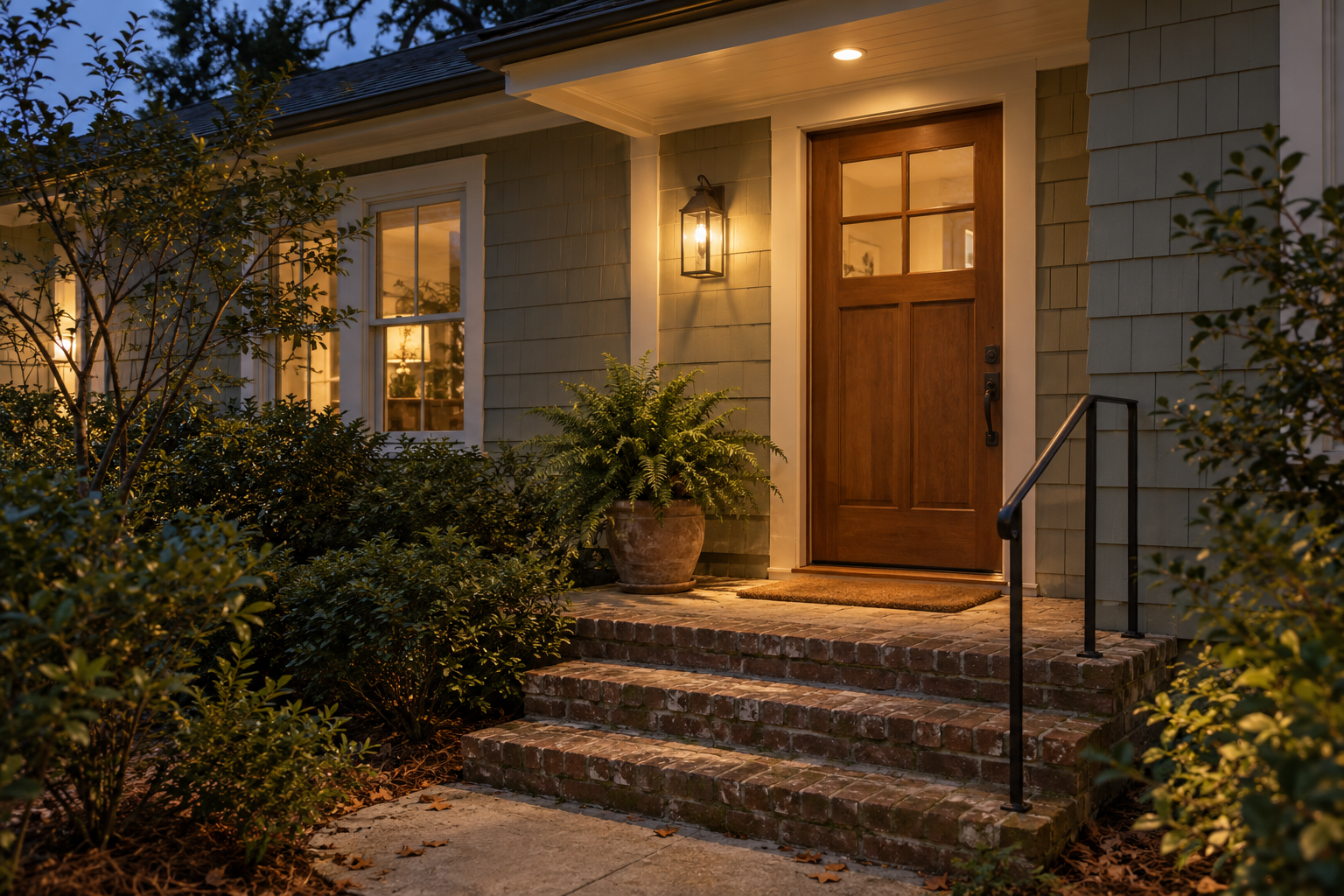
Make the front door feel like the destination.
Your entry should be easy to pick out without overpowering the rest of the house. Consider the porch lights you already have, then connect that welcome to the walk and steps leading up to it.
Explore path & outdoor living lightingLet the house and garden work together.
A brightly lit facade can leave the garden looking flat. A glowing tree can pull attention away from the front door. Looking at both together helps establish a clear focal point and a softer supporting layer.
Consider the view from the street as well as from inside. Bright fixtures should stay out of direct sight, with light aimed away from windows and neighboring properties. Every project includes an evening walkthrough to see the lighting after dark.
Explore landscape lightingSmall fixtures. Carefully chosen positions.
There isn’t one fixture layout for every home. These low-voltage lighting approaches give us a starting point, with placement shaped by your walls, planting beds, windows and existing lights.
Near the base of a wall or column.
Placement: Small spotlights can sit in planting beds near the house, aimed up at selected architectural features. Recessed well lights are another option where the site allows.
The effect: A focused beam draws attention to a column, an entrance surround or a section of the facade.
Positioned to wash or graze a wall.
Placement: Wall-wash fixtures spread light across a wider surface. Lighting closer to textured masonry can create a grazing effect that emphasizes its relief.
The effect: A softer wash brings a wall into view; grazing makes the brick or stone texture more pronounced.
On the building, directed down.
Placement: Suitable low-voltage fixtures can mount beneath an eave, on a wall or within a covered entry. The mounting surface and wiring route help determine what is practical.
The effect: Downward light can illuminate an entry or the area below without relying only on ground-mounted uplights.
The aim matters as much as the location. Beam width, shielding and brightness should keep light on the intended surface, away from windows and direct sightlines, and limit spill beyond the building. Exact fixture types and mounting options depend on the property. Our work focuses on low-voltage systems; high-voltage electrical work is not included.